AI×HPC Weekly Watch (2026-10-26): GTC Berlin Declares "AI Is Manufacturing" — DSX POD Industrializes AI-Factory Delivery, OpenShell Defines Agent Security Boundaries
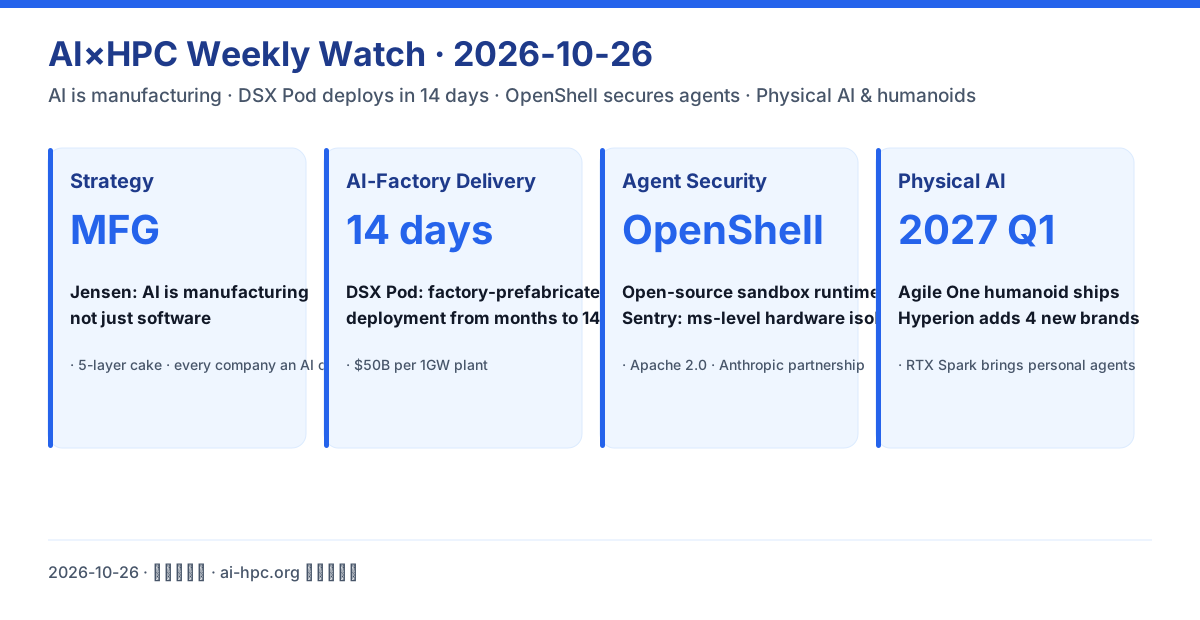
This is the AI-HPC expert team's weekly industry watch, based on public reports from October 19–26, 2026. Core judgment: this week's narrative is dominated by NVIDIA GTC Berlin — Jensen Huang articulated "AI is manufacturing" as a complete industrial framework for the first time, with two engineering levers: DSX POD turns AI factories into factory-prefabricated, transportable systems (on-site deployment compressed from months to 14 days), and OpenShell/Sentry move agent security from "constraints inside the model" to "enforcement at the system level". Together with last week's "RMB 4 trillion compute investment" policy narrative, AI infrastructure has formally entered its "manufacturing-ization" phase.
The week of October 19–26 was event-dense: NVIDIA GTC Berlin ran October 20–22, with Jensen Huang's keynote at Berlin's iconic Tempodrom on October 21 systematically arguing that "AI is not software, but manufacturing"; the company announced Vera Rubin in full production, the DSX POD reference design, the OpenShell/Sentry security runtime, the RTX Spark personal-agent PC line, and the Agile One reference humanoid. On October 20, DeepSeek fully open-sourced its production inference framework DeepInfer; between October 22 and 26, four smart-compute projects broke ground in the Helinger New Area with RMB 15.235 billion in total investment; and the 2026 OCP Global Summit (October 12–15) continued to reverberate with NVIDIA opening Vera Rubin rack designs. The timeline is below; the body follows four threads: industry strategy, compute delivery, agent security and on-device, and physical AI.
| Date | Event |
|---|---|
| 2026-10-12~15 | 2026 OCP Global Summit held in San Jose with 15,000 attendees; NVIDIA opens Vera Rubin rack designs |
| 2026-10-20~22 | NVIDIA GTC Berlin held; Oct 21 keynote at Tempodrom declares "AI is manufacturing" |
| 2026-10-21 | Huang announces Vera Rubin in full production, DSX POD, OpenShell/Sentry, RTX Spark, Agile One |
| 2026-10-20 | DeepSeek fully open-sources internal inference framework DeepInfer and token codec deepseek-recipe |
| 2026-10-22~26 | Four smart-compute projects break ground in Helinger New Area, RMB 15.235B total investment |
| 2026-10-26 | CICC research note: DSX POD system-level delivery may accelerate cloud compute monetization and improve ROI |
1. Industry Strategy: GTC Berlin Declares "AI Is Manufacturing", the Five-Layer Cake Reshapes the Narrative
On October 21, NVIDIA CEO Jensen Huang delivered the core judgment in his GTC Berlin keynote: AI is not merely a software technology but a manufacturing industry — a "five-layer cake" of energy, infrastructure, models, AI-native applications, and end industries — "you don't want to be just a consumer of AI, you want to produce AI," and every company will ultimately become an AI company ["https://36kr.com/p/4035763910219649"]. Framed as "the beginning of a new industrial revolution," the keynote also had a European dimension: after a weeklong road trip across Paris, London, Stockholm, and Dublin, NVIDIA committed nearly $10 billion to Europe's technology ecosystem and works with 12,000+ partners ["https://blogs.nvidia.com/blog/gtc-berlin-2026-keynote/"].
The hardware backbone is Vera Rubin entering full production: Huang called it "the world's first completely self-designed computer" — cable-free, wire-free, 100% liquid-cooled. Previously, assembling a Grace Blackwell node took about two hours with 80% liquid cooling; Vera Rubin assembly takes under five minutes. The MVLink switch tray connects 72 GPUs into one giant GPU (each GPU containing 20 chips); NVIDIA claims a one-million-fold AI performance improvement over the past decade — far beyond Moore's Law's 100× over ten years — with Blackwell roughly 30× faster than Hopper and Vera Rubin adding another ~30× on top of Blackwell, surpassing Blackwell's decade of progress in just two years ["https://36kr.com/p/4035763910219649"].
The implication for AI infrastructure: beyond GPUs, NVIDIA is redefining the competitive boundary with a "full-stack AI factory platform" — from GPU, CPU, networking, storage, and switching to system software, CUDA X libraries, models, and tools. A CICC research note the same week highlighted that NVIDIA management emphasized DSX POD system-level delivery could accelerate cloud compute monetization, shorten time-to-production, and improve ROI while pushing agents and on-device applications ["http://m.toutiao.com/group/7700813920260473387/"].
2. Compute Delivery: DSX and DSX POD — AI Factories Enter the "Factory-Prefabricated, Whole-System Delivery" Era
The most engineering-heavy content of the keynote was DSX (NVIDIA Data Center Systems Experience): "Outstanding chips alone do not make an outstanding AI factory," Huang said. DSX is a full-stack reference architecture co-innovated with the world's leading AI-factory infrastructure companies, co-designing compute, networking, storage, software, power, and cooling as one system ["https://36kr.com/p/4035763910219649"]. Design starts with digital twins: PTC turns equipment designs into simulation-ready assets, Schneider Electric simulates power distribution and liquid cooling, Jacobs integrates the Omniverse digital twin, Siemens assesses thermal and grid impact, and Procore supports construction-phase planning — performance, power, water, and scale are virtually validated before construction begins. The numbers are equally concrete: DSX Max LPS, an end-to-end control system, dynamically regulates power by workload and saves 30% power at the same output; Vera Rubin's closed-loop liquid cooling runs at up to 45°C coolant in suitable climates; a 2GW AI factory using dry coolers can save 54 million liters of water per day — equivalent to the daily water use of 180,000 households.
DSX POD productizes this further: built on Vera Rubin NVL72, seven liquid-cooled compute racks connected by ~17 km of Spectrum X cable form one DSX cabin, fully wired, integrated, and tested at the factory before being shipped in transportable containers; racks use dry coolers and 800V DC power, and on-site deployment is compressed from months to 14 days (the full install-to-first-token cycle shrinks from four to five months to about one month) ["http://m.toutiao.com/group/7699376316449161791/"] ["https://36kr.com/p/4035763910219649"]. The economics are stated plainly: a 1GW AI factory costs about $50 billion with hundreds of billions in expected annual revenue — a three-month delay could cost about $10 billion in revenue. Moving wiring, assembly, and testing into the supply chain turns time itself into the AI factory's biggest variable.
3. Agent Security and On-Device: OpenShell/Sentry Define "System-Level Enforcement", RTX Spark Brings Personal Agents to Laptops
Huang decomposed an agent into five elements: model, exoskeleton (coordinating memory and tool activation), sandbox, knowledge, and tools — "agents are autonomous systems that can access files, resources, networks, and tools. Hope is not security; security is technology and engineering" ["https://36kr.com/p/4035763910219649"]. This leads to NVIDIA OpenShell: an open-source (Apache 2.0) agent security runtime that defines policies per agent and enforces them at system granularity — system calls, file access, and network connections are constrained inside the sandbox; every policy change passes formal verification and caps permission ceilings, so agents can never gain access beyond what was intended. NVIDIA Sentry adds an optional hardware-isolated layer: running on BlueField 4, away from the agent, it executes runtime policy and can sever the connection to the model and isolate it in milliseconds if the agent attempts something dangerous, while keeping verifiable audit records — Anthropic and NVIDIA are collaborating on cloud-hosted OpenShell agents ["https://36kr.com/p/4035763910219649"].
On-device compute scales in parallel: after four years of collaboration with Microsoft, NVIDIA introduced the RTX Spark PC product line (powered by the N1X chip developed in stealth over four years), turning personal computers into "personal agents/personal assistants"; a Windows-based DGX workstation (20 PFLOPS, 754 GB memory) ships by year-end ["https://36kr.com/p/4035763910219649"]. In a live demo, an agent running on an RTX Spark laptop (Hermes agent framework + Neotron and GPT-6 Astra models + FreeCAD/Blender/Isaac Sim/Newton physics engines) completed a full creation loop — modeling, simulation, massively parallel training in cloud Isaac Lab, and downloading the policy back to a real robot — building and running AI agents and their accelerated tools can be done on a laptop ["https://36kr.com/p/4035763910219649"].
4. Physical AI and European Industry: Hyperion Adds Four Brands, Agile One Humanoid Ships in Q1 2027
Huang defined the next wave as physical AI — AI that understands and reasons about the physical world — spanning radio/tower beamforming (lifting spectrum efficiency like ray tracing did for graphics), robot-assisted adaptive radiotherapy, and autonomous driving. NVIDIA unveiled the Hyperion standard autonomous-driving reference architecture: 14 cameras, 9 radars, 3 short-range radars, and ultrasonic sensors driven by dual NVIDIA GPUs; four new brands and four vehicle models join the Hyperion fleet — Volkswagen van, Jaguar Land Rover, Volvo fleet, and the next-generation Mercedes product ["https://36kr.com/p/4035763910219649"]. On robotics, NVIDIA argued that "standardized configurations start the technology flywheel" (phones, PCs, and MVLink72 all scaled because of standardization) and introduced the NVIDIA Robotics Agile One reference humanoid, built with Agile Robotics: pre-assembled with on-board compute and integrated software, shipping in Q1 2027 ["https://36kr.com/p/4035763910219649"].
European industrial adoption was the other centerpiece: industrial AI at Siemens Erlangen, media-workflow intelligence for the European Broadcasting Union (EBU), and Google Cloud accelerators reaching general availability were announced in parallel, complementing NVIDIA's ~$10 billion European ecosystem commitment — the story of "AI factories industrializing from Berlin" ["https://blogs.nvidia.com/gtc-berlin-2026-news/"]. For AI×HPC, physical AI's three computers (training, digital twin, and in-vehicle/on-robot) map directly onto three compute forms — training clusters, Omniverse digital-twin compute, and edge inference — significantly widening the demand envelope for AI infrastructure.
Other news this week
- DeepSeek open-sources DeepInfer (Oct 20, Apache 2.0): 155 trillion tokens/day per cluster, $38 revenue per GPU-hour at API off-peak pricing, ~82% gross margin; supports NVIDIA SM100 and Ascend 950; 3–7 day KV-cache retention (agent/chat) — inference economics quantified in public for the first time ["https://36kr.com/p/4035800747578243"] ["http://m.legaldaily.com.cn/Company/content/2026-10/21/content_9475886.htm"].
- Helinger RMB 15.2B smart-compute groundbreaking (Oct 22–26): Wangsu Data (37,000P), Yungang Intelligent (200MW liquid cooling), CIFC zero-carbon, and Guanguang Xinwang projects broke ground — the East-Data-West-Compute green-compute hub keeps expanding ["https://inews.nmgnews.com.cn/system/2026/10/26/030416617.shtml"].
- OCP 2026 opens Vera Rubin racks: NVIDIA contributed Vera Rubin rack and compute-tray designs to OCP via MGX, with Cisco, Google, Meta, and Microsoft among adopters ["https://www.opencompute.org/news/2026-ocp-global-summit-by-the-numbers/"].
Takeaways
- The AI-factory evaluation model upgrades from "chip lists" to "system delivery". Vera Rubin's cable-free/100% liquid-cooled design, DSX POD's factory prefabrication plus 14-day on-site deployment, and the $50B-per-1GW cost structure mean that planning for 10K-scale clusters must include delivery form (prefabricated vs. on-site integration), cooling method (evaporative vs. dry/closed-loop), and power architecture (800V DC) as first-class project variables — a three-month delay is now literally a $10B-revenue statement.
- Agent security will become an infrastructure layer like cybersecurity. OpenShell (Apache 2.0) externalizes sandboxing, policy, and formal verification outside the model; Sentry provides millisecond isolation in a hardware trust domain — engineering teams building agent platforms should treat "permission ceilings + runtime isolation + audit trails" as architecture decisions at the same level as model selection, not as post-hoc patches; the open-source implementation lowers the barrier.
- Compute forms are splitting three ways. Physical AI's three computers (training, digital twin, on-device), personal-agent on-device inference (RTX Spark), and the public quantification of inference economics (DeepInfer) all show that cluster construction is no longer "one generic GPU pool" — networks, caches, and power must be planned separately for training, simulation, inference, and on-device workloads. This is the industry-side evidence for the "supercompute-intelligent-compute fusion" route under the AI-HPC converged architecture.
Compiled from public reports for research and engineering reference; facts and figures are subject to the original sources.