AI×HPC Weekly Watch (2026-10-19): 100K-Card Supercluster Debuts, RMB 4T Compute-Network Investment, NVHBM Standardization, and AI Scores 98% on Theoretical Physics
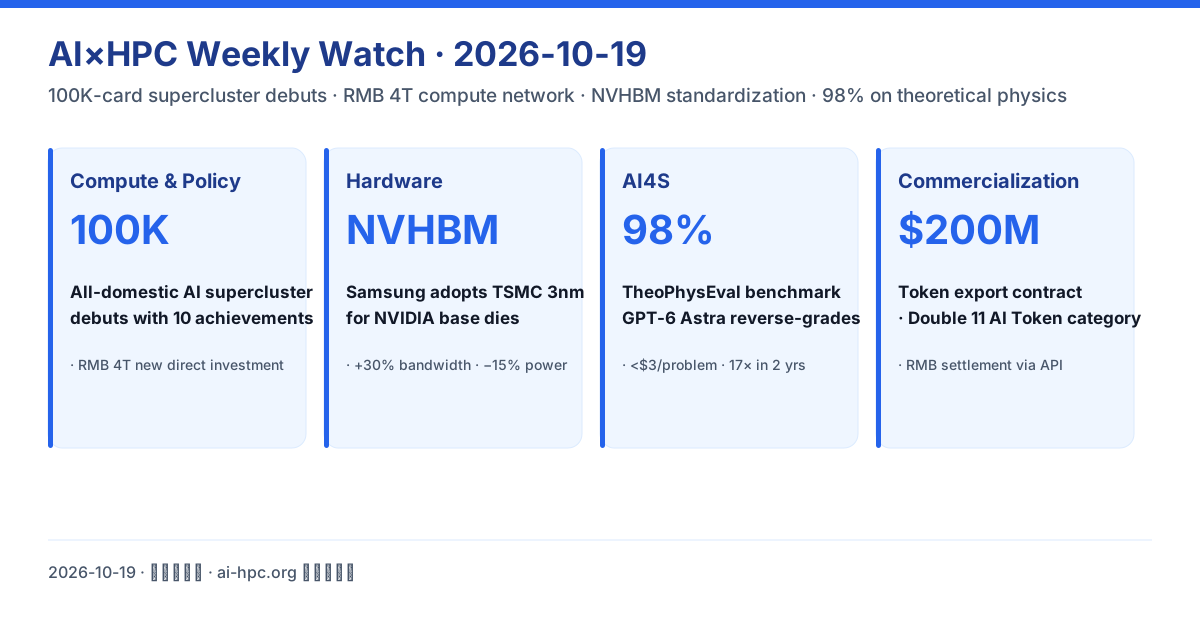
This is the AI-HPC expert team's weekly industry watch, based on public reports from October 13–19, 2026. Core judgment: this week's narrative is defined by three "standardization moments" — domestic compute moves from "built" to "deployed with application results", the AI memory supply chain unifies around NVIDIA's spec, and frontier AI for the first time "reverse-grades" human experts on a theoretical-physics benchmark. On the policy side, the "RMB 4 trillion" direct-investment figure formally enters the public conversation.
The week of October 13–19 was event-dense: on October 14, China National Radio reported that "15th Five-Year" compute-network construction will draw RMB 4 trillion in new direct investment; on October 16, the compute network was explicitly named one of the six "national networks" under planning; on October 18, CCTV Finance reported the true-machine debut of China's first all-domestic 100K-accelerator AI supercluster at the 2026 National High-Performance Computing Academic Conference with ten application achievements — the same day Korean media reported Samsung will use TSMC's 3nm process to make NVHBM base dies for NVIDIA, RunJian signed a $200M Token export contract, and Tmall's Double 11 listed "AI Token" as a product category for the first time; on October 19, the TheoPhysEval theoretical-physics benchmark results went viral, with GPT-6 Astra scoring 98% after the reference answers were revised. The timeline is below; the body follows four threads: compute infrastructure and policy, hardware supply chain, AI4S, and new compute commercialization.
| Time | Event |
|---|---|
| 2026-10-14 | China National Radio: Opinions on Developing New Quality Productive Forces; RMB 4 trillion new direct investment in the "15th Five-Year" compute network |
| 2026-10-16 | The compute network is explicitly named one of the six national networks under planning |
| 2026-10-18 | CCTV Finance: all-domestic 100K-accelerator AI supercluster debuts with ten application achievements |
| 2026-10-18 | Korean media: Samsung to use TSMC 3nm for NVIDIA NVHBM base dies |
| 2026-10-18 | RunJian signs a $200M Token cross-border sales contract; Tmall Double 11 lists "AI Token" as a category |
| 2026-10-19 | TheoPhysEval results: GPT-6 Astra scores 98% after reference answers revised |
I. Compute Infrastructure and Policy: A 100K-Card Supercluster Debuts; the "RMB 4 Trillion" Compute-Network Investment Opens
On October 18, CCTV Finance reported that China's first all-domestic 100K-accelerator AI supercluster made its true-machine debut at the 2026 National High-Performance Computing Academic Conference in Shenzhen, alongside ten major application achievements. The system interconnects 100,000 domestic AI accelerators via high-speed fabric, fusing supercomputing and AI computing on a single compute substrate — capable of both high-precision scientific computing and large-model training/inference. The applications include digital-twin brain and universe-evolution simulation, demonstrating how domestic large-scale compute systems are being applied to scientific research ["https://m.guancha.cn/CaiJing/2026_10_19_904894.shtml"] ["http://www.globaltimes.cn/page/202610/1372462.shtml"]. Compared with the earlier "completed construction" milestone, a "true-machine debut + application results" step means the 100K-card system is now demonstrating converged HPC×AI capability under real workloads — a landmark validation of the "one substrate, two kinds of computing" thesis this site has repeatedly emphasized.
The policy side sent equally strong signals. On October 14, China National Radio reported that the CPC Central Committee and State Council issued the Opinions on Developing New Quality Productive Forces, proposing 19 key measures across five areas and explicitly calling for a comprehensive "AI+" campaign; related agencies estimate that "15th Five-Year" compute-network construction will draw RMB 4 trillion in new direct investment, with enterprise investment as the main vehicle, creating large room for private capital. In execution, the three telecom operators are the main investors: China Mobile completed RMB 61 billion in H1 2026 capex with compute-network investment up 71% year on year; China Unicom's full-year capex of RMB 50 billion includes over RMB 17.5 billion in compute-related investment, about 35% of the total. MIIT data shows China's intelligent-compute capacity reached 2,185 EFLOPS in H1 2026, up 177% year on year ["http://finance.cnr.cn/ycbd/20261014/t20261014_527841851.shtml"]. On October 16, the compute network was further designated one of the six "national networks" under planning, with official statements describing the compute industry as entering an accelerated development phase with broad prospects ["http://m.163.com/dy/article/L9JNB33E0514R9L4.html"].
Two signals deserve engineering teams' attention: first, "RMB 4 trillion" lifts compute investment from project-level to national-balance-sheet-level, a clear tailwind for compute, storage, and network vendors; second, terms such as "compute–power coordination" and "2,185 EFLOPS intelligent compute" are now in mainstream coverage, meaning next-generation cluster evaluation must put power, network, and software ecosystem on the same table as GPU counts.
II. Hardware Supply Chain: NVHBM Standardization — Samsung's First HBM-Making Cooperation with TSMC
On October 18, Korea's Seoul Economic Daily, citing supply-chain sources, reported that Samsung Electronics plans to use TSMC's 3nm process to fabricate the base die for NVIDIA's next-generation custom high-bandwidth memory (NVHBM); NVIDIA has asked Samsung, SK Hynix, and Micron to unify the process, reducing performance variance and validation burden across suppliers. This marks the first cooperation between Samsung and TSMC in the HBM manufacturing stage; Samsung will keep its own memory-plus-foundry integrated route for standard HBM products ["https://www.cls.cn/detail/2508018"] ["https://www.eet-china.com/news/202610192085.html"].
NVHBM itself is a systematic re-architecture of HBM: NVIDIA moves the memory controller into the 3D HBM stack rather than onto the XPU. According to NVIDIA, compared with standard HBM4E, NVHBM delivers up to 30% higher memory bandwidth, reduces HBM power by 15%, and frees up to 25% of XPU die area for compute ["https://blogs.nvidia.cn/blog/category/enterprise/feed/"]. At the supply-chain level, "unified base process + unified sixth-generation DRAM (1c) core process" means HBM manufacturing shifts from "each vendor its own chain" to a division-of-labor ecosystem standard. For downstream cluster planning, the implication: next-generation flagship GPU memory subsystems will depend heavily on TSMC advanced-packaging capacity, and HBM supply may move from "three-way competition" to "three vendors sharing one underlying process, differentiating at the top layer."
For AI infrastructure engineers, NVHBM confirms that "memory bandwidth equals compute": with bandwidth up 30% and power down 15%, the same training throughput maps to a smaller rack power budget — liquid-cooling and power-supply planning should be recalculated for the new memory architecture.
III. AI4S: TheoPhysEval — GPT-6 Astra Scores 98% on Theoretical Physics
On October 19, TheoPhysEval, a theoretical-physics benchmark co-designed by leading global institutions, shook the academic community (paper arXiv:2610.16733). To avoid public question banks already absorbed by models, the organizers — including ICTS, TIFR, UT Austin, the University of Tokyo, Harvard, UPenn, Duke, and Google DeepMind — sourced all 50 problems from unpublished research notes: hard problems spanning quantum field theory and holography that even top experts in the subfield need a day or more to solve, with analytical expressions forced into high-precision numeric outputs with distractor terms to rule out guessing.
The results are landmark: GPT-6 Astra scored about 88% initially, but in review it "reverse-graded" the human experts — providing complete derivations and pointing out subtle errors in the reference answers (sign mistakes, misapplied approximations); after the experts corrected the standard answers, Astra's score rose to 98% (49 of 50 problems solved); even in a fully offline "isolation track", Astra and Claude Opus 5.5 both scored 92%. Average API Token cost per problem: under $3 ["https://36kr.com/p/4031321004397193"]. The broader trend comes from MIT measurements: frontier AI solved about 2% of such problems in mid-2024, rising to 35% by mid-2026 — roughly a 17× capability increase with no visible slowdown. Notably, the only problem all models failed — reconstructing an autonomous differential equation from a noisy trajectory (problem 1b) — demands "physical intuition" and reverse thinking; every top model turned in a blank.
This story echoes last week's domestic-model proof of the 3D Ghys conjecture: AI for Science is moving from "solving problems" to "correcting and reviewing". When a model can point out flaws in human derivations, the validation loop expands from "humans verify AI" to "AI and humans verify each other". Two implications for research teams: first, make "independent AI review" a default step in the paper and experiment workflow; second, models still clearly fail on problems requiring physical intuition or reasoning under information asymmetry — the human holding the wheel is not going away anytime soon.
IV. New Compute Commercialization: Token Export Contracts and E-commerce Categories
Two "firsts" in compute commercialization this week. On October 18, RunJian disclosed that its wholly-owned subsidiary Wuxiang Yungu signed an AI Token cross-border sales service contract with an overseas customer, with a minimum annual purchase amount of $200 million: all compute resources are deployed inside China, the overseas customer calls large-model inference via API across borders, and settlement is in RMB based on actual Token consumption; if annual consumption falls short of $200 million, the customer must make up the difference ["https://m.guancha.cn/CaiJing/2026_10_19_904894.shtml"]. The same day, at a Double 11 media briefing, Tmall's president confirmed that large-model vendors including Zhipu and MiniMax have opened stores on Tmall, and this year's Double 11 introduces "AI Token" as a product category for the first time, with plans to bundle learning kits and family kits for one-person companies, small teams, and home learners, alongside AI-prebundled laptops ["https://m.guancha.cn/CaiJing/2026_10_19_904894.shtml"].
The shared signal of the two "firsts": Token is moving from an "API metering unit" to a "good that can be settled cross-border and retailed on e-commerce". For the compute supply side, inference-service business models are splitting from project/subscription into "metered + channel" forms — deployment location, settlement currency, and sales channel become new differentiation dimensions. For engineering teams, a "per-Token billing" cost structure (rather than per-GPU-hour) will in turn demand finer KV-cache, batching, and quantization optimization to amortize per-Token cost.
Takeaways
- Compute-investment evaluation must keep up with the "national balance sheet" scale. With RMB 4 trillion in direct investment and a 2,185 EFLOPS intelligent-compute official figure, the logic of cluster projects is shifting from "single-project ROI" to "infrastructure assets" — engineering teams should treat power coordination, network interconnection, and software ecosystem as decision dimensions as important as GPU procurement.
- Memory supply-chain standardization changes hardware-planning assumptions. Once NVHBM unifies the base process, flagship-GPU memory bandwidth and power profiles shift up as a whole — liquid cooling, power, and rack-density plans need recalculation for the new memory architecture; and since HBM supply now depends on advanced-packaging capacity, cluster delivery timelines should factor in this external dependency as a risk.
- AI4S validation enters the "human–AI mutual verification" phase. From a domestic model proving a math conjecture to GPT-6 Astra reverse-grading human physicists' derivations, scientific workflows should build "independent AI review" in early; at the same time, models still have hard limits on problems requiring physical intuition and reverse thinking — the responsibility for validation remains with human teams.